
Competitor Backlink Analysis: 2026 Method
A complete process for choosing comparable competitors, finding missing referring domains, reviewing source pages, and turning backlink data into realistic link-building actions.
The short answer
A useful competitor backlink analysis compares your website with three to five realistic competitors, finds sources that recur across their profiles, opens every relevant referring page, and ranks opportunities by topical fit, context, and feasibility.
The goal is not a giant export. It is a short list of pages and contacts where you understand why the competitor earned the link and what your website could genuinely contribute. If you need a refresher on links, anchors, and referring domains, start with our guide to what a backlink is.
What competitor backlink analysis can reveal
A public backlink profile leaves clues about the content, relationships, and campaigns that earned attention in a market. Those clues are useful when they are connected to the actual source pages.
Reachable sources
Publications, partners, resource pages, associations, comparisons, specialist directories, and marketplaces that already mention similar businesses.
Link-worthy content formats
Research, statistics, tools, guides, glossaries, rankings, case studies, and genuinely useful product pages.
Likely acquisition methods
Digital PR, contributions, partnerships, broken-link replacement, brand mentions, directories, or sponsored placements.
Acquisition pace
Steady growth, a short campaign, a product launch, or a spike connected to one successful publication.
The data cannot expose every private agreement behind a link, and it cannot prove that one backlink caused a ranking. Treat the profile as evidence to investigate, not as a ready-made strategy.
Select three to five genuinely comparable competitors
Competitor selection shapes the whole report. A national publisher or giant marketplace may rank for the same query, but its links can be impossible for a smaller business to reproduce. Build a balanced comparison set.
| Competitor type | Why include it | Watch out for |
|---|---|---|
| Direct business competitor | Similar offer, customer, and market | Private partnerships may be impossible to reproduce |
| Search competitor | Its pages appear for the same topics as yours | Its business model may be completely different |
| Similar-sized website | Its opportunities are usually more realistic in the short term | Confirm that it serves the same audience |
| Market leader | It reveals strong formats and relationships in the sector | Use it to learn, not to set immediate targets |
For page-level work, compare exact URLs instead of whole domains. A software comparison should be measured against pages answering the same question, not against every backlink earned by each brand.
Build a baseline for your own website first
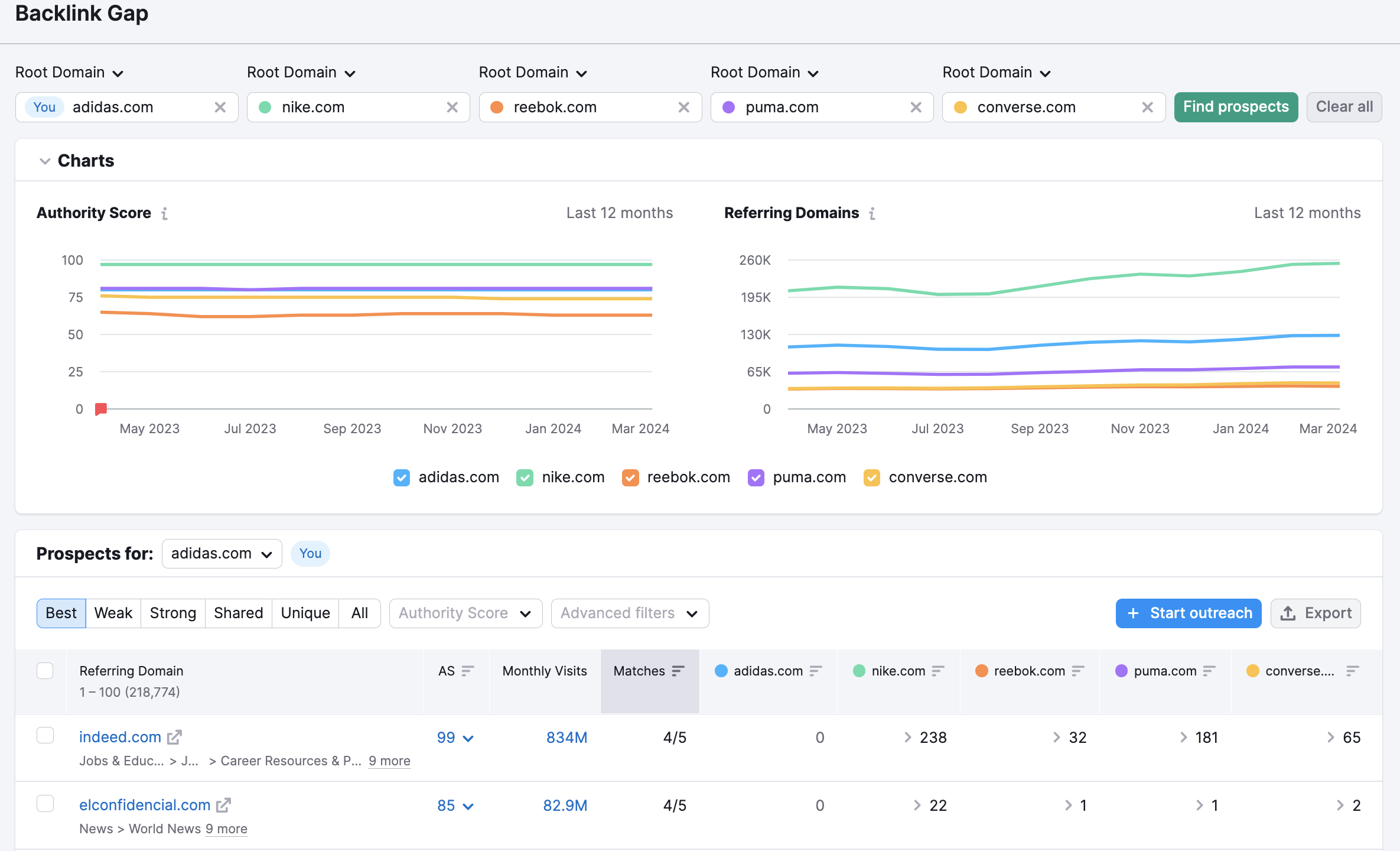
Include your domain in the comparison. Otherwise, you can see competitor links but not the gap that matters to you. Record at least referring domains, top-linked pages, dominant anchors, and recent new or lost links.
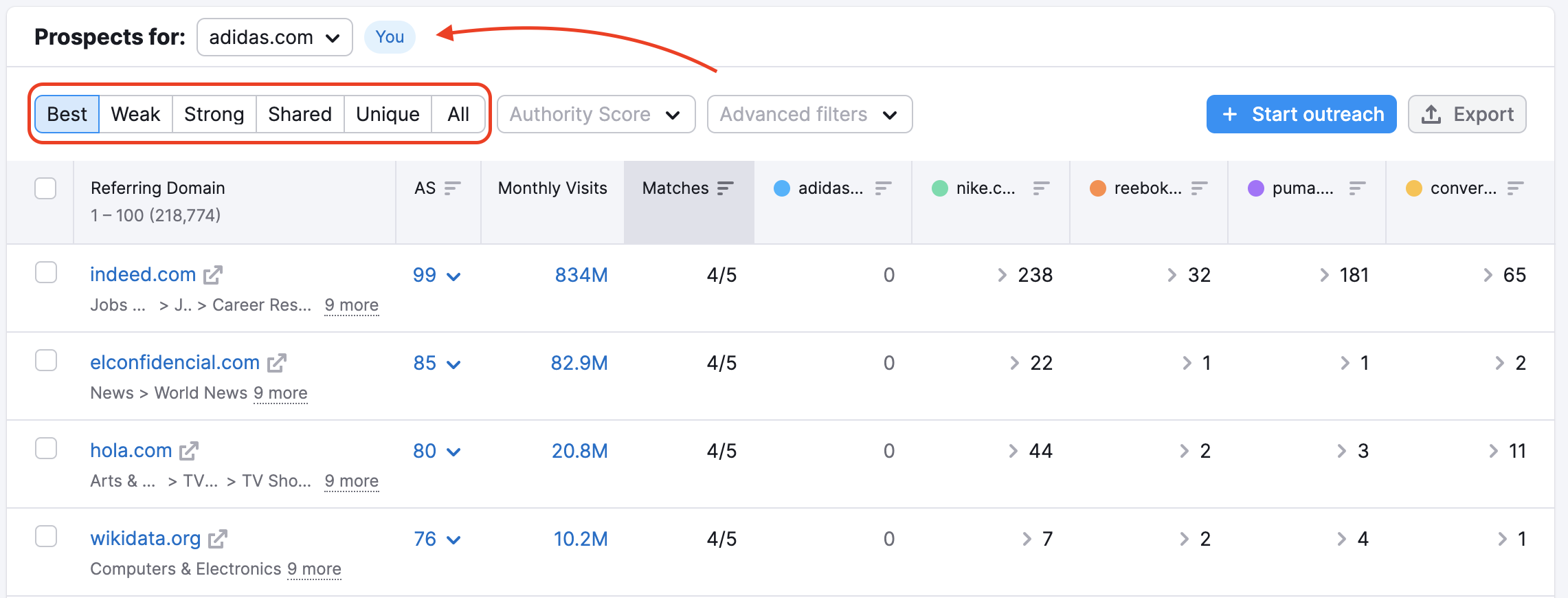
Semrush labels sources as best, weak, strong, shared, or unique. Ahrefs Link Intersect offers a similar comparison at referring-domain or referring-page level. Keep the scope consistent across every target: root domain, subdomain, or exact URL.
Start with referring domains shared by several competitors
A source found across three of four comparable competitors deserves attention before a random one-off domain. Recurrence suggests the publication already understands the market or regularly covers companies like yours.
- Show domains linking to competitors but not to your website.
- Sort by the number of competitors matched before sorting by authority.
- Remove technical subdomains, content-free aggregators, and unrelated sources.
- Open the backlink count for each competitor to reach the exact referring pages.
- Save the source URL, competitor destination, page type, and date observed.
Open the referring page before scoring the opportunity
Domain-level authority does not explain why a link exists or where it appears. Two backlinks from the same website can have very different practical value.
| Check | Promising sign | Weak sign |
|---|---|---|
| Page topic | Readers could genuinely need your resource | The domain is relevant but the page is not |
| Reason for the link | Evidence, tool, definition, example, partner, or named solution | Unexplained link in a mass-produced list |
| Placement | Visible contextual link that helps the reader continue | Footer, repeated block, or link-heavy area |
| Destination | The competitor page answers the surrounding need | Redirect, error, thin page, or unrelated destination |
| Freshness | Maintained page with working links and current information | Abandoned content that is no longer reviewed |
Inspect nearby outbound links as well. Editorial context, link density, and anchor usage often tell you more than the website's headline metric.
Classify the probable reason each link was earned
Add one short “type” field to your spreadsheet. A limited set of categories is enough to turn raw data into a plan.
- Editorial citation: research, a statistic, definition, or resource supports an article.
- Resource page or comparison: several products, services, or references are listed together.
- Real partnership: client, supplier, association, integration, event, or testimonial.
- Contribution: interview, opinion piece, podcast, webinar, or guest article.
- Broken link: the competitor destination has disappeared and a comparable resource could replace it.
- Brand mention: the company is cited for a launch, data point, expert comment, or news event.
- Commercial placement: sponsored content, directory listing, or marketplace offer.
The classification tells you whether the next step is improving content, finding a contact, offering expertise, replacing a dead resource, or checking a commercial price.
Score opportunities without relying on one authority metric
A lightweight 0–2 score keeps the largest metric from winning every decision. Review high totals first, but reject any line with a clear relevance, quality, or risk problem.
| Criterion | 0 points | 1 point | 2 points |
|---|---|---|---|
| Topical fit | Unrelated | Adjacent | Same topic and audience |
| Recurrence | No comparable competitor | One competitor | Several competitors |
| Page quality | Thin or abandoned | Acceptable | Useful, readable, and maintained |
| Ability to contribute | No credible reason | Possible improvement | A clearly better-fit resource is ready |
| Contact path | None identified | Generic contact | Author, owner, or clear process |
| Cost and risk | Disproportionate or questionable | Needs review | Acceptable and transparent |
Use Ahrefs, Semrush, and Majestic for different questions
Backlink tools maintain different indexes and proprietary metrics, so their totals will not match exactly. Use each source for the job it handles well.
Ahrefs
Link Intersect, referring domains, best-linked pages, new and lost links, anchors, and profile trends.
Semrush
Backlink Gap, competitor matches, source filters, and the path from gap analysis to prospects.
Majestic
Trust Flow, Citation Flow, Topical Trust Flow, context, and the neighborhood around links.
Majestic adds topical context
Topical Trust Flow indicates the categories in which a page or domain receives influence. Compare that signal with the actual source page instead of treating the metric as an automatic verdict.
To run these checks without stacking direct subscriptions, compare the Rankerfox pages for Ahrefs, Semrush, Majestic, and multi-tool backlink analysis.
Bring LinkFinder in only after SEO qualification
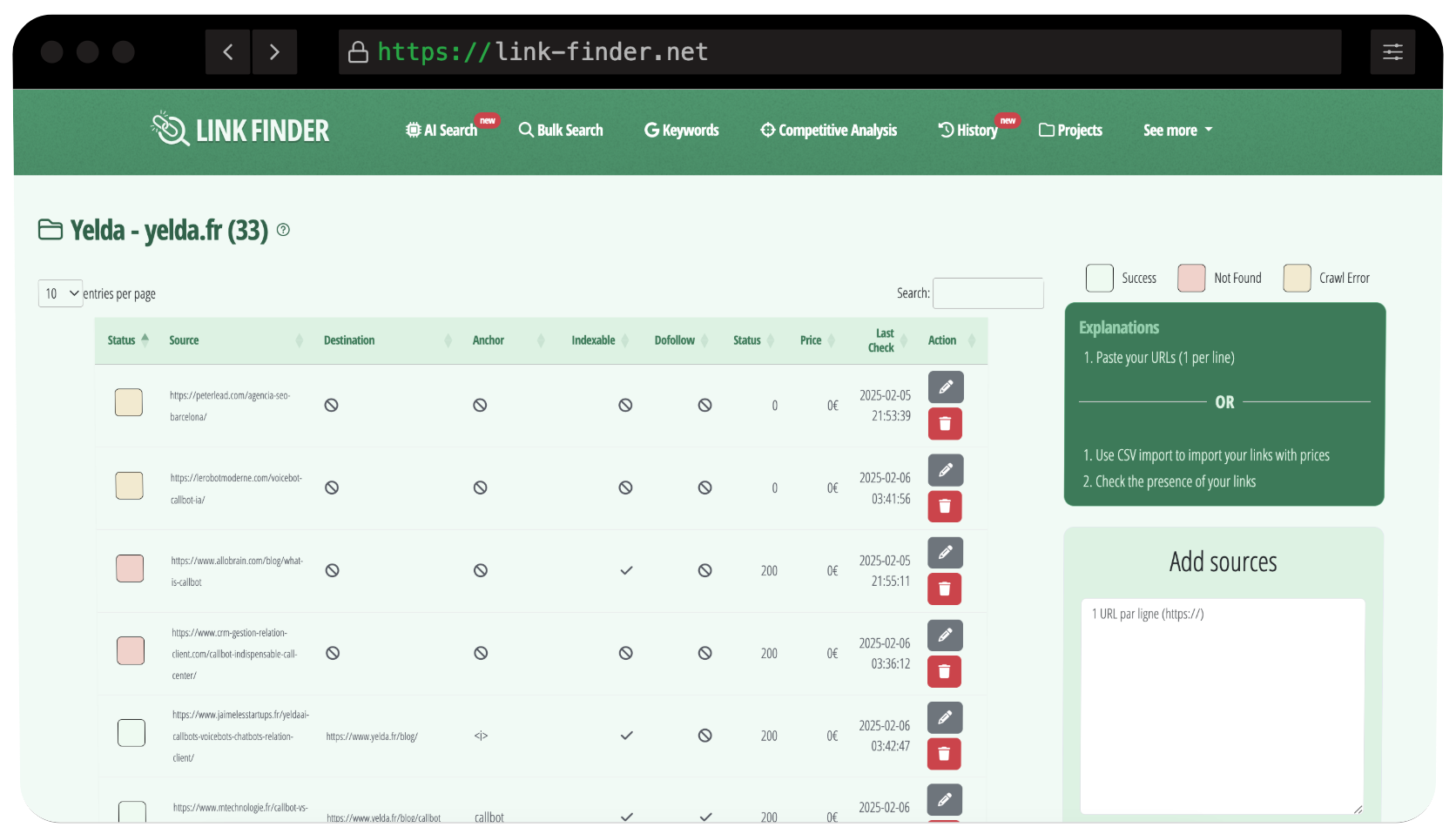
LinkFinder is an external service, not an included Rankerfox tool. It can check whether domains found in competitor profiles appear across the marketplaces it compares. That helps with availability and price research, but it does not prove that a placement should be purchased.
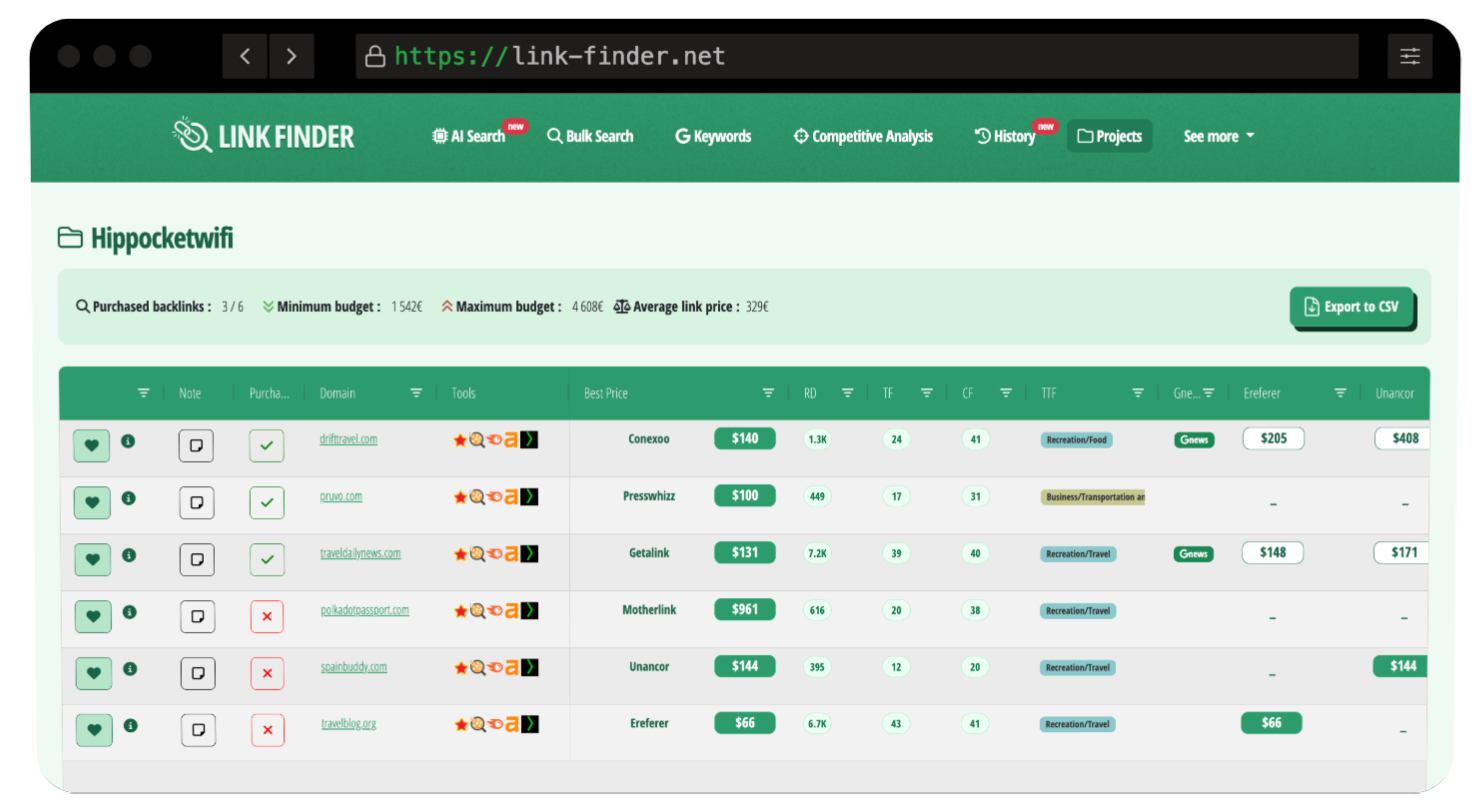
Our detailed LinkFinder review explains competitor search, projects, pricing, and limitations. If paid placements are part of the plan, also read our guide to backlink prices, platforms, and risks.
Example: turn 1,800 domains into ten credible actions
Imagine a field-service management product for small contractors. Four comparable competitors are analyzed, producing 1,800 domains that do not link to the product. Sensible filtering reduces the list quickly.
| Stage | Remaining volume | Decision |
|---|---|---|
| Initial export | 1,800 domains | No action: raw data |
| Found across at least two competitors | 240 domains | Open categories and referring pages |
| Compatible topic and audience | 64 domains | Identify the reason for each link |
| Live page and reproducible opportunity | 23 domains | Record the asset needed and the contact |
| High priority | 10 actions | Start a small personalized campaign |
Those ten actions may include supplying a statistic to a guide, joining a legitimate partner page, replacing a dead resource, answering a journalist, or reviewing a sponsored placement. Precision is what makes the analysis usable.
Base outreach on the page you actually reviewed
“You link to my competitor” is not a reason to act. A good message explains what you saw and how your proposal improves the page.
A simple structure
- Name the page and passage you genuinely read.
- Explain the function of the competitor link in one sentence.
- Offer a resource, correction, or expertise that serves the same need.
- Provide the URL and let the editor decide without dictating anchor text.
Our SEO outreach guide covers contact research and follow-up. The guide to earning quality backlinks provides ten practical methods for turning qualified leads into action.
Monitor new and lost links every month
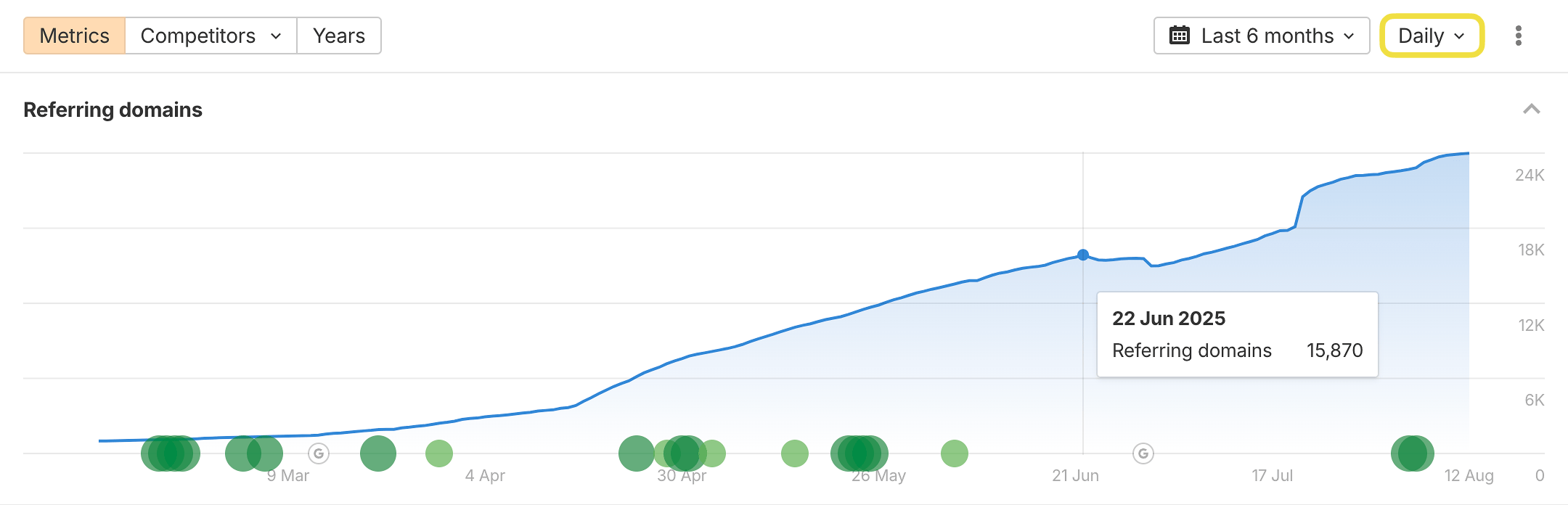
A one-off audit captures one moment. A light monitoring routine reveals active campaigns, newly successful resources, and recently lost links.
- Track new referring domains for three priority competitors.
- Investigate meaningful spikes instead of every small daily change.
- Add useful sources to your working list with the discovery date.
- Check the status and final destination of links you earn.
- Reassess the competitor set every quarter.
Common mistakes that make the report useless
- Copying every backlink: some links come from relationships, events, or campaigns that have nothing to do with your website.
- Sorting only by authority: a modest specialist page can be more useful than a powerful but unrelated domain.
- Never opening URLs: exports include redirects, deleted pages, image links, and irrelevant placements.
- Confusing domains with pages: a website's reputation does not automatically describe every URL it publishes.
- Forcing the same anchor everywhere: anchor text should follow the editorial sentence and relationship.
- Buying before qualification: marketplace availability does not guarantee relevance, audience, or stability.
- Ignoring your own asset: even an excellent prospect list struggles when the proposed page is interchangeable.
Keep paid-link rules in view
Google defines buying or selling links for ranking purposes as link spam. Advertising and sponsorship links are allowed when qualified with rel="sponsored" or rel="nofollow". Competitor analysis cannot tell you whether an observed placement is compliant, editorial, or low-risk.
Before spending money, review the page, expected duration, link attributes, commercial disclosure, and actual reader value. Read the official Google link spam policy for the current wording.
Where Rankerfox fits in the process
Rankerfox brings together several analysis tools used at different stages: Ahrefs for exploring and intersecting sources, Semrush for profile comparison, Majestic for topical context, and additional tools for content and outreach preparation. LinkFinder remains a separate external service.
Shared access is best suited to regular but measured analysis. If you need bulk exports, an API, a strictly individual account, or intensive daily use, compare the publishers' direct subscriptions as well.
Compare the tools before starting your audit
Review Rankerfox plans and make sure the available access matches your working frequency.
Official sources used
- Ahrefs: using Link Intersect to find referring domains and pages.
- Semrush: Backlink Gap comparison, matches, and filters.
- Majestic: Site Explorer, referring domains, context, and metrics.
- Majestic: official Trust Flow and Topical Trust Flow definitions.
- LinkFinder: competitive research, projects, and backlink monitoring.
- Google Search Central: link spam policies.
Frequently asked questions
What is a backlink gap?
It is the set of domains or pages that link to one or more competitors without linking to your website. It becomes an opportunity only after you verify the topic, source page, and reason for the link.
How many competitors should I analyze?
Three to five are usually enough for a first study. Mix direct business competitors, sites appearing in the same search results, and at least one website with a comparable size.
Should I compare domains or exact URLs?
Use domains to understand overall strategy. Compare exact URLs when working on a specific guide, category, product page, or comparison.
Why do Ahrefs and Semrush show different totals?
Each tool has its own crawler, index, and calculation rules. Compare patterns and open the source pages instead of expecting identical totals.
Is a domain that links to several competitors always a priority?
No. Recurrence suggests familiarity with the market, but the page may be unrelated, inaccessible, commercial, or weak. It deserves review, not automatic outreach.
Can I replicate every competitor backlink?
No, and you should not try. Some links depend on a relationship, history, event, or unique resource. Identify the mechanism you can adapt honestly.
How often should I repeat the analysis?
A light monthly review of new links and a deeper quarterly analysis suit many websites. Adjust the schedule to your market and the number of actions you can actually complete.