
What Is a Backlink? Definition, SEO Value and Quality Signals
Learn what a backlink is, why links matter for SEO, how anchors and referring domains work, and how to assess follow, nofollow and sponsored links.
The simple definition
A backlink, also called an inbound link, is a link on another website that points to a page on your website. When a publication, partner, directory, or blog cites your page through a clickable link, your page receives a backlink.
That link may help readers discover your content, send referral traffic, and give search engines more context about the cited page. Its value depends far more on the source and surrounding content than on the fact that a link exists.
What does a backlink look like?
A backlink connects a source page on an external domain to a destination page on your website. The clickable words between them are the anchor text.
SOURCE WEBSITE
An article recommends your guide
“Read this backlink guide.”
YOUR PAGE
The destination receiving the link
It gains a new entry point for readers and search engines.
In HTML, the link may be as simple as:
<a href="https://example.com/backlink-guide">backlink guide</a>hrefcontains the destination address.- Backlink guide is the visible anchor text.
- The page containing the code is the backlink source.
Google explains that a link is normally crawlable when it uses an HTML <a> element with an href attribute resolving to a real web address. A visual button or text styled like a link is not always interpreted in the same way.
Backlinks, external links and internal links
The name changes with the point of view. If website A links to website B, it is an outbound external link for website A and an inbound backlink for website B.
| Link type | Source | Destination | Main purpose |
|---|---|---|---|
| Internal link | A page on your website | Another page on the same website | Navigation, discovery, and content structure |
| Outbound link | Your website | Another domain | Citing a source or guiding the reader |
| Backlink | Another domain | Your website | Providing a citation, traffic, and topical context |
Internal links are essential, but they do not become backlinks simply because they point to an important page. A backlink requires a link from a different domain.
Why backlinks matter for SEO
Google says it uses links to find new pages and as a signal when assessing relevance. That does not mean one backlink automatically raises a ranking. Search systems combine many signals, and two links can carry very different meaning.
Discovery
A crawlable link can help search crawlers and readers reach a newly published page.
Context
The source page, surrounding sentence, and anchor help describe the cited destination.
Editorial recognition
Relevant citations from several websites can show that a resource is worth consulting.
A backlink may also succeed without a visible ranking change. A reader can click, discover your offer, subscribe, or contact you. This referral traffic is easy to miss when links are reduced to authority scores.
Backlinks and referring domains are not the same metric
The backlink total counts every detected link. The referring domain total counts distinct websites that send at least one link.
If a partner adds your URL to the footer of 500 pages, a tool may report 500 backlinks but only one referring domain. Ten editorial citations on ten separate websites represent ten backlinks and ten referring domains.
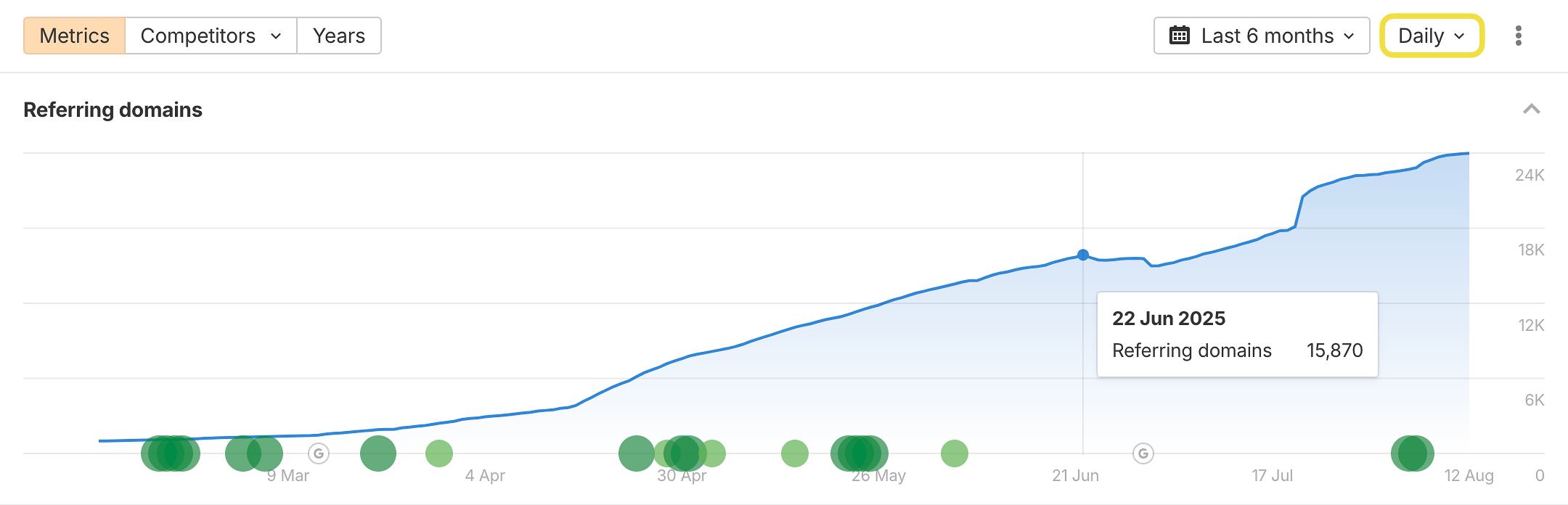
Read both numbers, then inspect where the links come from. A sudden jump may be a successful campaign, a sitewide link, or a wave of low-value sources.
Follow, nofollow, sponsored and ugc links
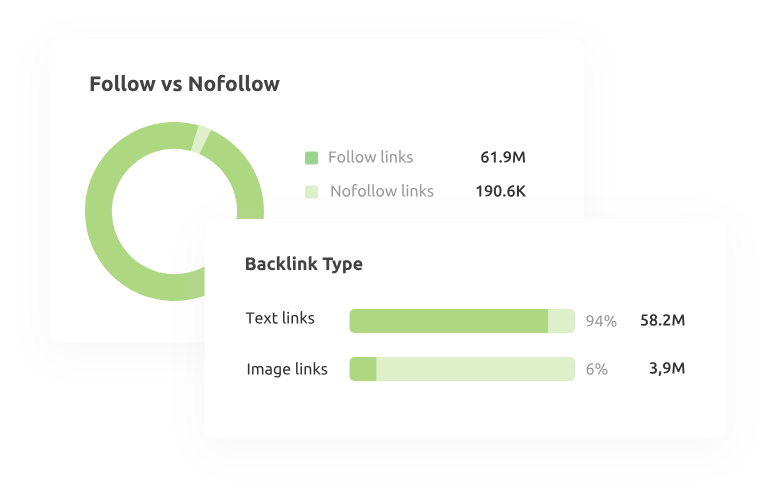
SEO discussions often use the word “dofollow,” but a rel="dofollow" attribute is not required. A standard HTML link with no special relationship value is simply a link that Google can generally crawl and consider.
| Form | When it fits | What it communicates |
|---|---|---|
| Standard link | A freely chosen editorial citation | No special relationship is declared |
rel="sponsored" | Advertising, affiliate links, paid placements, or sponsored partnerships | The link exists in a commercial relationship |
rel="ugc" | Comments, forums, and other user-generated content | The website owner did not necessarily choose the citation |
rel="nofollow" | When the other values do not apply and the source does not want an association | The source is not offering a standard endorsement |
Values can be combined, for example rel="sponsored nofollow". They describe the relationship with the destination; they do not hide the URL, which may still be discovered elsewhere.
What is anchor text?
Anchor text is the visible, clickable part of a link. It sets expectations for the reader. Google recommends anchors that are descriptive, concise, natural, and supported by useful surrounding text.
Brand
“Rankerfox” or the exact name of the cited website.
URL
“rankerfox.fr” or the full destination address.
Descriptive
“backlink analysis method” naturally describes the destination.
Generic
“Learn more” can work in context but says little when read alone.
Repeating the same commercial keyword in every anchor can look manufactured. A natural profile usually includes brand names, URLs, descriptive phrases, and context-led anchors. When an image is linked, its alternative text may serve as anchor text.
What makes a quality backlink?
No single score can make the decision for you. A strong backlink first makes sense for the reader and for the two pages it connects.
- A relevant source: the site or page covers your topic, audience, or a closely related need.
- A real page: it offers useful content and was not created only to host outgoing links.
- Clear editorial context: the surrounding sentence explains why the resource is cited.
- Natural anchor text: it describes the destination without forcing a keyword string.
- The right destination: the target page fulfils the promise made by the anchor.
- A stable, visible source: the domain retains activity, indexed pages, and a coherent history.
- Source diversity: the profile does not depend on one website, one format, or one anchor.
Semrush, Ahrefs, and Majestic metrics help with triage, but each uses its own data and methodology. Combine those indicators with the exact source page, topical fit, history, and existing outbound links.
Which backlinks deserve closer inspection?
A weak link is not automatically harmful. It may simply provide no value. Concern grows when several signals point to artificial creation or a source that has nothing to do with your market.
- Pages packed with outgoing links to unrelated industries.
- The same commercial anchor repeated across many domains.
- Mass-created comments, profiles, or directories with no reader value.
- Websites whose topic or publishing volume changes abruptly.
- Pages that are inaccessible, non-indexable, duplicated, or quickly removed.
- Guaranteed ranking claims based only on link volume.
Google's spam policies include links bought for ranking manipulation, excessive exchanges, automated link programs, paid articles with optimized anchors, and low-quality links distributed at scale. Advertising and sponsorship links remain normal web practices when they are properly qualified.
How to analyze a website's backlinks
Start with a precise question: are you investigating a decline, comparing a competitor, checking a campaign, or preparing a new target page?
| Signal | Question to ask |
|---|---|
| Referring domains | How many distinct sources cite the site, and in which topics? |
| New and lost links | Is the profile growing steadily, or showing unusual spikes and losses? |
| Anchors | Does the distribution look natural and relevant to the target pages? |
| Most linked pages | Which resources genuinely attract citations? |
| Source quality | Are the pages relevant, visible, stable, and editorially credible? |
| Referral traffic | Do readers actually use any of these links to reach the website? |
Our dedicated page explains how to run an affordable backlink analysis using several data sources. You can then compare the approaches offered by Ahrefs, Majestic, and Semrush.
How to earn your first backlinks
A sensible starting point is not placing the same URL everywhere. It is creating a clear reason for another page to cite yours.
- Publish original research, a comparison, a tool, or a resource that other authors can use.
- Introduce that resource to relevant writers, partners, or publications already covering the topic.
- Find pages that cite a competitor but miss information your resource provides.
- Turn an existing unlinked brand mention into a link when it helps the reader.
- Replace a broken source with an up-to-date and relevant destination.
- Join legitimate associations, events, or professional resources that list their members.
Our complete guide explains how to earn quality backlinks with ten methods, an outreach example, and a 30-day plan. Buying links is a separate route with SEO risk and commercial terms to understand. Our guide to buying backlinks, prices, and platforms explains those choices without confusing them with earned editorial citations.
Rankerfox tools for understanding your link profile
Rankerfox brings together several tools that observe the same backlink profile from different angles. Ahrefs explores referring domains and linked pages, Majestic adds link graphs and trust metrics, while Semrush connects backlinks with a wider domain and competitor analysis.
The goal is not to copy three scores into a report. It is to compare data, open the source pages, and decide which links deserve investigation, outreach, or a new action.
Move from the definition to your own profile
Compare the available tools and build a more reliable view of your backlinks.
Frequently asked questions
Is every backlink good for SEO?
No. Some links provide context, traffic, or a genuine citation; others are neutral, artificial, or published on pages with no value. Source, page, anchor, and destination matter more than the raw total.
How many backlinks do I need to rank?
There is no universal number. The need varies with competition, content quality, existing authority, and the pages already ranking. Study genuinely comparable results instead of chasing an arbitrary quota.
What is the difference between a backlink and a referring domain?
A backlink is one individual link. A referring domain is one distinct website sending one or more links. One hundred links from the same website equal one hundred backlinks but one referring domain.
Is a nofollow link useless?
No. It can send visitors, expose a resource to a new audience, and form part of a natural citation profile. The attribute mainly describes the relationship between pages; it does not make the link invisible to readers.
Should I disavow every bad backlink?
No. One low-quality link does not automatically require action. Disavowal is an advanced measure, mainly relevant when there is a substantial history of artificial links or a manual action. Start by reviewing the full profile and the actual circumstances.
Does Google Search Console show every backlink?
Search Console provides a useful sample of top links, not necessarily a complete inventory. Comparing several tools can reveal more sources, after which the important pages should be checked manually.
Useful sources: read Google's link best practices, its guidance on sponsored, ugc, and nofollow, and the official link spam policies.