
GPT-5.6 Sol, Terra and Luna: Complete Guide
GPT-5.6 Sol, Terra, and Luna are available. Compare their roles, ChatGPT, Work, Codex and API access, pricing, context, performance, and best use cases.
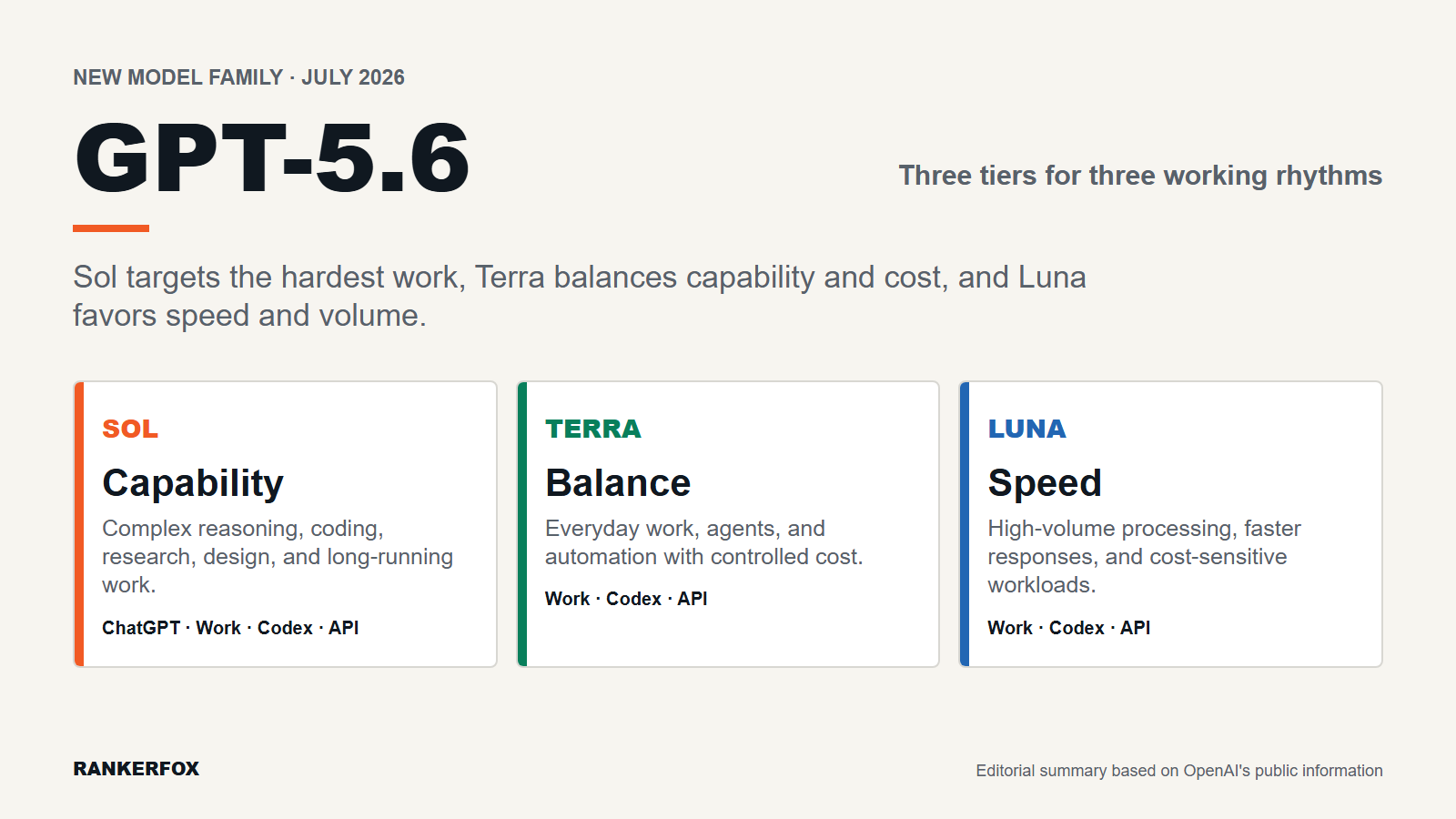
GPT-5.6 at a glance
Updated September 26, 2026: the next generation is covered in our GPT-6 Astra, Sol and Luna comparison. Terra remains a GPT-5.6 model.
OpenAI launched GPT-5.6 Sol, GPT-5.6 Terra, and GPT-5.6 Luna on July 9, 2026. The family is available across ChatGPT, ChatGPT Work, Codex, and the OpenAI API, but the three names do not appear in the same way in every product.
The short answer
- GPT-5.6 Sol is the flagship model for the hardest work.
- GPT-5.6 Terra aims for the best balance of capability, speed, and cost.
- GPT-5.6 Luna targets fast, high-volume, cost-sensitive workloads.
- In standard ChatGPT conversations, Sol is the only one of the three used directly. Terra and Luna are mainly available in ChatGPT Work, Codex, and the API.
The naming change matters. OpenAI is no longer presenting only a large model with mini and nano variants. Sol, Terra, and Luna are described as durable capability tiers that can progress on their own cadence. The 5.6 number identifies the generation, while the name identifies the model's place in the family.
What really separates Sol, Terra, and Luna
The three models share a broad technical foundation: configurable reasoning, text and image input, Responses API tools, a stated 1.05 million-token context window, and up to 128,000 output tokens. That does not mean they deliver equal quality or retain every detail equally well across a very long input.
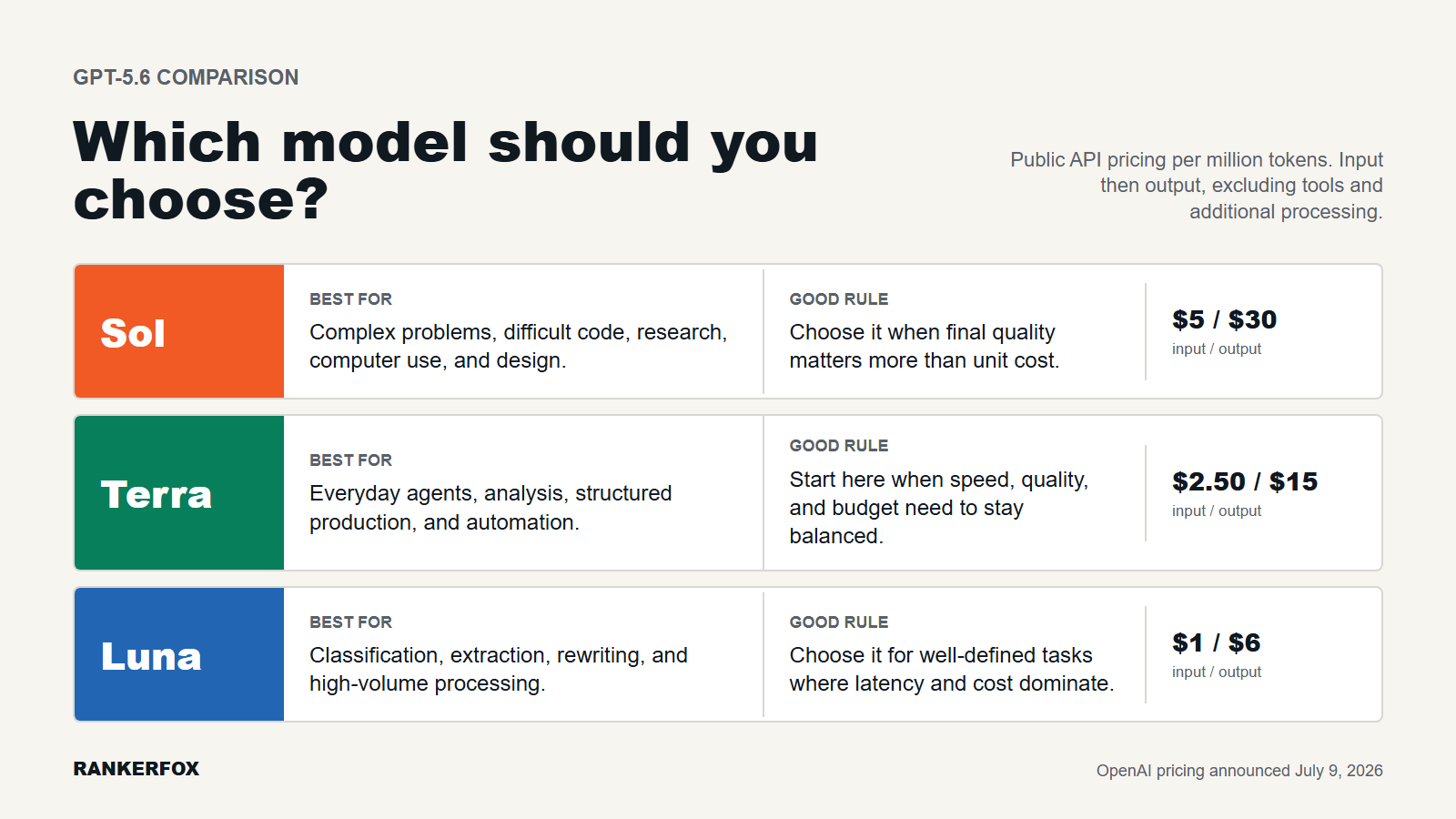
| Model | Position | Best suited to | API input / output price |
|---|---|---|---|
| GPT-5.6 Sol | Flagship | Complex reasoning, coding, research, computer use, design, and long-running work | $5 / $30 per million tokens |
| GPT-5.6 Terra | Capability/cost balance | Everyday agents, analysis, structured production, and automation | $2.50 / $15 per million tokens |
| GPT-5.6 Luna | Speed and volume | Classification, extraction, rewriting, and well-defined work at scale | $1 / $6 per million tokens |
Where is GPT-5.6 available?
Availability needs careful reading. Saying that GPT-5.6 is in ChatGPT is true, but incomplete: the model picker and accessible tiers change by product and plan.
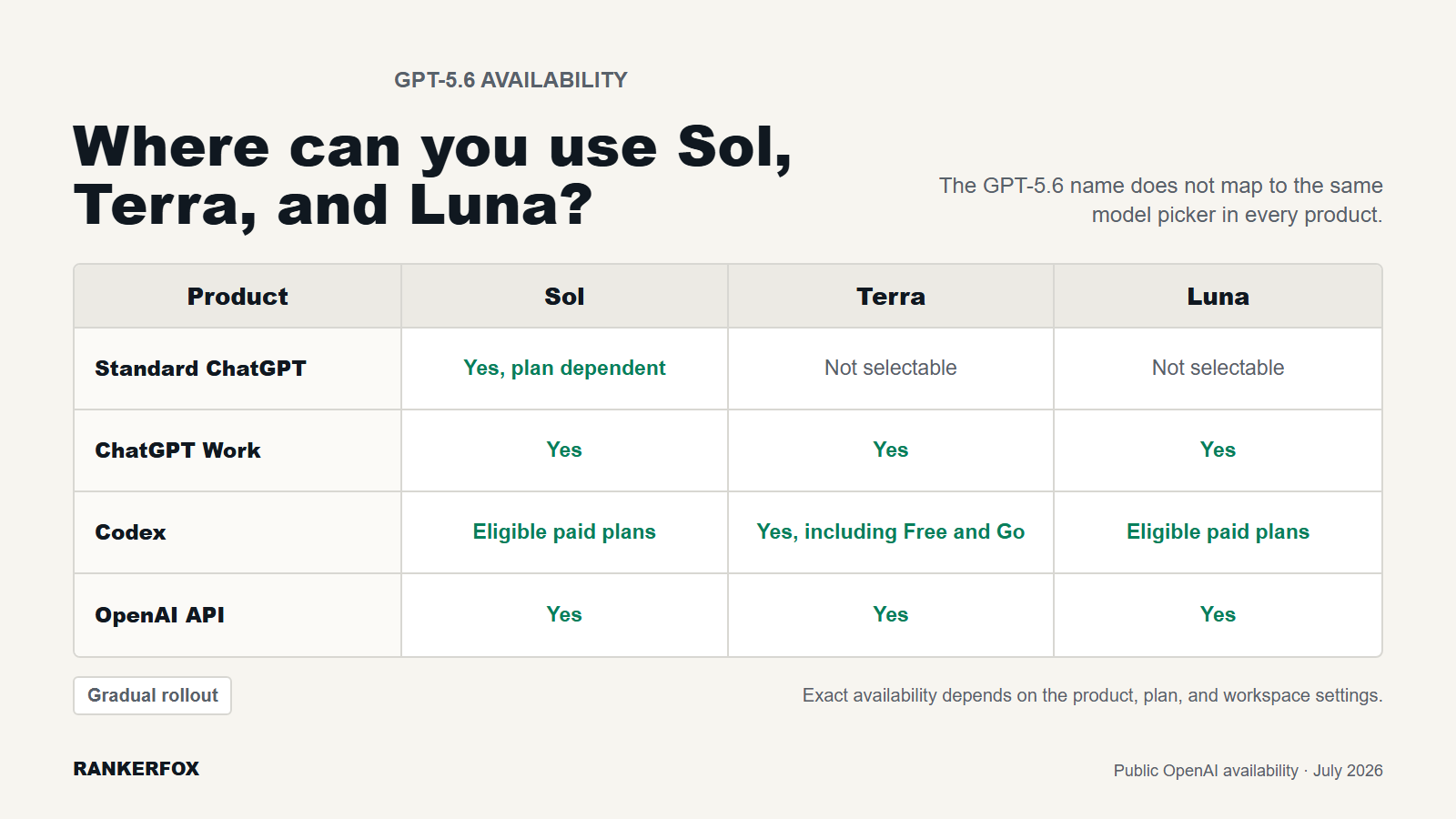
- Standard ChatGPT: GPT-5.6 Sol powers Medium, High, and Extra High reasoning on eligible plans. GPT-5.6 Sol Pro powers Pro.
- ChatGPT Work: Sol, Terra, and Luna are available to Plus, Pro, Business, and Enterprise users, subject to rollout and workspace settings.
- Codex: Terra is available to Free and Go. Plus, Pro, Business, and Enterprise can choose Sol, Terra, and Luna.
- OpenAI API: all three are available as
gpt-5.6-sol,gpt-5.6-terra, andgpt-5.6-luna. Thegpt-5.6alias routes to Sol.
How GPT-5.6 appears inside ChatGPT
GPT-5.5 Instant remains the default choice for quick conversations. ChatGPT can automatically switch from Instant to Medium when a request needs more reasoning, provided automatic switching is enabled.
| ChatGPT option | Model used | Announced availability |
|---|---|---|
| Instant | GPT-5.5 Instant | Remains the everyday default |
| Medium and High | GPT-5.6 Sol | Plus, Pro, Business, and Enterprise |
| Extra High | GPT-5.6 Sol | Pro, Business, and Enterprise |
| Pro | GPT-5.6 Sol Pro | Pro, Business, and Enterprise |
Terra and Luna are therefore not two extra buttons in a standard ChatGPT conversation. They become selectable in Work and Codex, or directly callable through the API.
GPT-5.6 Sol: built for difficult work
Sol is the flagship member of the family. OpenAI positions it for complex tasks that combine multiple steps, tools, and a high bar for the finished result: software engineering, research, professional analysis, defensive cybersecurity, science, computer use, and design.
Its value goes beyond giving a better answer. Sol can inspect an environment, use tools, follow a long task, produce an initial result, then check and refine it. That makes it particularly useful for:
- understanding a codebase before changing several files;
- combining sources and turning research into a usable report;
- creating documents, spreadsheets, and presentations that follow an existing structure;
- building and visually checking an interface across desktop and mobile;
- work where a mistake costs more than the extra token spend.
In ChatGPT, Sol powers Medium, High, and Extra High. Sol Pro reserves more capability for the hardest and longest tasks. In Work and Codex, max is available to users with GPT-5.6 access. OpenAI says ultra, which can coordinate several agents, is available in Work for Pro and Enterprise and in Codex from Plus upward.
GPT-5.6 Terra: the balanced choice
Terra may be the most practical starting point for many professional workflows. It costs half as much as Sol in the API while keeping the same nominal context window, the same 128,000 maximum output tokens, and access to the main Responses API tools.
It fits work where serious analysis matters but the flagship model is not needed every time:
- everyday agents using search, files, and tools;
- document analysis and structured synthesis;
- content, plans, tables, and meeting-note production;
- automation that needs reasoning and runs frequently;
- regular development, targeted fixes, and agent subtasks.
OpenAI's published results show Terra beating GPT-5.5 on some coding, browsing, and computer-use evaluations while costing less. That does not make it a universal replacement for Sol; the compromise is the point.
GPT-5.6 Luna: speed, volume, and controlled cost
Luna is the fastest and least expensive model in the family. It is not designed to beat Sol on the most subtle files. Its natural territory is a clear, repeatable task that may need to run hundreds or thousands of times.
It can make sense for:
- classifying large lists of queries, pages, products, or messages;
- extracting fields from semi-structured text;
- normalizing titles, summaries, or descriptions;
- producing short variations that will be reviewed;
- running a first filter before handing difficult cases to Terra or Sol.
At $1 input and $6 output per million tokens, Luna is attractive at scale. Long-context and reasoning evaluations show a wider gap from Sol and Terra, however. The same technical context-window size does not guarantee the same ability to retrieve and connect every detail.
Are the announced performance gains really strong?
Yes, the progress is substantial, but it should be read benchmark by benchmark. OpenAI's launch table shows Sol performing strongly on coding, browsing, computer use, and several professional tasks. Terra often lands close to Sol or above GPT-5.5. Luna remains competitive, with performance per dollar as its clearest advantage.
| Published evaluation | Sol | Terra | Luna | GPT-5.5 |
|---|---|---|---|---|
| Artificial Analysis Coding Agent Index | 80 | 77.4 | 74.6 | 76.4 |
| Terminal-Bench 2.1 | 88.8% | 87.4% | 84.7% | 85.6% |
| BrowseComp | 90.4% | 87.5% | 83.3% | 84.4% |
| OSWorld 2.0 | 62.6% | 50.2% | 45.6% | 47.5% |
These numbers do not guarantee the quality of a specific response. They are most useful for understanding relative strengths. Real work also depends on the context, available tools, reasoning level, time budget, and verification process.
Context, images, tools, and technical limits
In the API, all three models list a 1,050,000-token context window, up to 128,000 output tokens, and a February 16, 2026 knowledge cutoff. They accept text and image input but do not directly accept audio or video on these model endpoints.
Through the Responses API, Sol, Terra, and Luna can use tools including:
- web search and file search;
- image generation and code interpreter;
- hosted shell and patch application;
- computer use, MCP, skills, and tool search;
- function calling and structured outputs.
Long context also has a pricing consequence. Above 272,000 input tokens, OpenAI says input is priced at 2x and output at 1.5x for the entire request. Selecting the right sources is often more efficient than pouring in a million unfiltered tokens.
API pricing and prompt caching
| Model | Input | Cached input | Output |
|---|---|---|---|
| GPT-5.6 Sol | $5 | $0.50 | $30 |
| GPT-5.6 Terra | $2.50 | $0.25 | $15 |
| GPT-5.6 Luna | $1 | $0.10 | $6 |
Prices are per million tokens. GPT-5.6 adds explicit cache breakpoints and a stated minimum cache life of 30 minutes. Cache writes cost 1.25 times the uncached input rate, while reads retain a 90% discount. For an agent that repeatedly uses long instructions or the same corpus, cache design may matter almost as much as model choice.
What GPT-5.6 adds for agents and coding
The 5.6 family is more than a new benchmark score. OpenAI highlights several features built for agentic workflows:
- Programmatic Tool Calling: the model can write and run small in-memory programs to coordinate tools and process intermediate results.
- Multi-agent beta: one request can distribute work across subagents and synthesize the results.
- Persisted reasoning: long-running tasks can maintain better continuity across steps.
- Original-dimension images: the API accepts original or automatic image detail for relevant visual work.
- Reasoning levels: Sol, Terra, and Luna support efforts from none through max in the API, with extra options depending on Work and Codex.
For developers and teams automating work, the most useful gain may come from coordination: better tool selection, result checking, and subproblem delegation, rather than a longer answer alone.
Uses for SEO, content, and marketing
GPT-5.6 can strengthen an SEO or editorial workflow when the right tier is used and current sources remain part of the process.
- Sol: combine several audits, connect technical and content findings, plan corrections, review code, compare scenarios, or build an internal tool.
- Terra: synthesize exports, prepare briefs, organize editorial calendars, turn notes into useful structures, and automate recurring checks.
- Luna: classify keywords, group intent, normalize metadata, extract entities, or run a first pass over high-volume material.
A model does not automatically know today's rankings, prices, pages, or trends. Recent work needs reliable supplied data or the appropriate search tools. Public-facing text should then be reviewed for facts, natural tone, and unsupported generalizations.
Which GPT-5.6 model should you choose?
A practical method is to start with the least expensive tier capable of completing the task, then move upward only when the result justifies it.
- Choose Luna when the instruction is stable, the output is short, and the volume is high.
- Move to Terra when the task needs more context, tools, or judgment.
- Use Sol for complex, ambiguous, or expensive-to-fail problems.
- Reserve Sol Pro, max, or ultra for work where longer reasoning or multiple agents add real value.
A cascading workflow can be efficient: Luna handles volume, Terra reviews intermediate cases, and Sol takes the difficult files. Test that split against your own examples because the best routing depends on the data and acceptable error rate.
What this changes for ChatGPT Pro with Rankerfox
ChatGPT Pro is listed in the Rankerfox Premium plan. GPT-5.6 makes that access more relevant for long research, coding, files, and multi-pass work. It does not mean all three names will instantly appear in every interface: the visible model depends on the OpenAI product, rollout, plan, and current session allowance.
Continue exploring
Read the ChatGPT Pro with Rankerfox page, compare the available AI tools, and review Rankerfox pricing. During a gradual rollout, the model picker shown in the current session remains the most concrete availability check.
Limits and points to verify
GPT-5.6 remains probabilistic. A fluent answer can still contain an error, a weakly connected source, or an overconfident conclusion. The closer a task is to customer data, legal decisions, health, finance, cybersecurity, or public commercial claims, the stronger human review should be.
- Do not send secrets, API keys, passwords, or personal data without an appropriate framework.
- Check citations, calculations, prices, dates, and recent claims.
- Test real examples before automating a high-volume workflow.
- Monitor long-context, tool, and output-token costs.
- Plan a fallback when an allowance or reasoning level is temporarily unavailable.
OpenAI also states that GPT-5.6 combines model-trained protections with real-time checks and stronger monitoring. Some higher-risk biological or cybersecurity requests may be refused or receive additional review.
Frequently asked questions about GPT-5.6
Is GPT-5.6 already available in ChatGPT?
Yes, with a gradual rollout. On eligible plans, Medium, High, and Extra High use GPT-5.6 Sol, while Pro uses GPT-5.6 Sol Pro. GPT-5.5 Instant remains the fast default.
Can I select Terra or Luna in a standard ChatGPT conversation?
No. OpenAI says Terra and Luna are not selectable in standard conversations. They are available in ChatGPT Work and Codex depending on plan, and through the API.
Which GPT-5.6 model is the most capable?
GPT-5.6 Sol is the flagship. Sol Pro and higher reasoning settings target the hardest tasks. Terra is the balanced tier and Luna is optimized for efficiency at scale.
Is Luna better than GPT-5.5?
Not on every evaluation. Luna beats GPT-5.5 on some tests and trails it on others. Its main advantage is delivering strong capability at lower cost and latency.
What is the GPT-5.6 context window?
All three API pages list a 1,050,000-token context window and 128,000 maximum output tokens. Real long-context quality still varies by model and by how the information is structured.
How much does GPT-5.6 cost in the API?
Per million tokens, Sol costs $5 input and $30 output, Terra $2.50 and $15, and Luna $1 and $6. Tools, input above 272,000 tokens, and some processing options can change the final cost.
Does GPT-5.6 replace GPT-5.5 Instant?
No. GPT-5.5 Instant remains ChatGPT's default fast mode. GPT-5.6 Sol takes over when more reasoning is requested.
Official sources
The specifications, pricing, and availability in this guide were checked against OpenAI's public pages on July 12, 2026: